


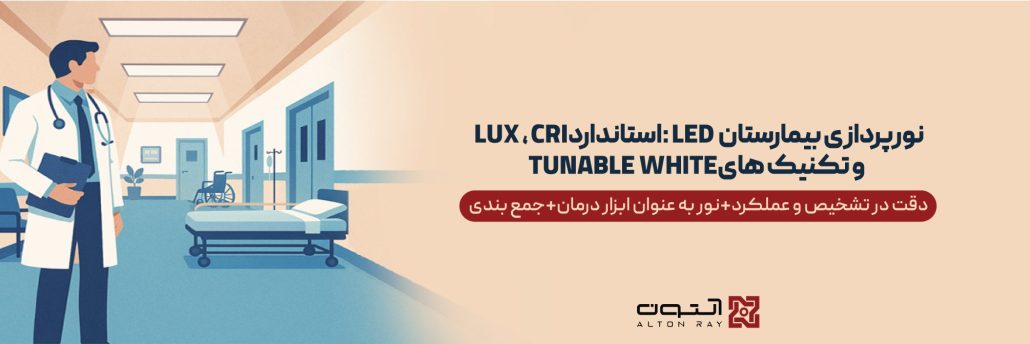
Lighting in healthcare facilities (hospitals, clinics and medical centres) is a life-critical matter. Light in these spaces must not only maximise diagnostic accuracy and the performance of medical staff, it must also act as a therapeutic tool, helping to align patients’ circadian rhythm and speed up recovery. When designing hospital lighting systems, ignoring key metrics such as CRI (Colour Rendering Index), lux levels and Tunable White control can directly harm patient health and the quality of care.
For operating rooms, laboratories and clean areas, see Alton Ray cleanroom LED lights; for corridors, offices and patient areas, browse our office LED lighting panels.
This article is a specialist guide to the essential standards of hospital lighting.
1. CRI and Lux: Accuracy in Diagnosis and Performance
In clinical environments, the quantity of light (lux) must be combined with the quality of light (CRI) to achieve the best results.
1.1. High CRI (Ra > 90): A Must for Operating and Examination Rooms
CRI (Colour Rendering Index) measures how accurately a light source reveals the true colours of objects.
- Why it matters: in operating theatres, recovery rooms and examination areas, doctors and surgeons need very accurate light to judge vital signs, skin tone, oxygenation and the colour of tissue and blood. A low CRI (below 80) distorts real colours and can lead to diagnostic or surgical errors.
- Standard: for critical areas such as operating and delivery rooms, CRI should be at least 90 (Ra > 90), preferably with a strong red rendering value (R9).
- Alton Ray’s approach: specialised full-spectrum LED chips that, in addition to a high general CRI, emphasise accurate rendering of reds and yellows (linked to skin and blood tones).
1.2. Recommended Lux Levels for Critical Areas
Illuminance (lux) must match the precision required by each activity:
| Hospital area | Minimum average lux | Purpose |
|---|---|---|
| Operating table (surgical field) | 1,000–2,000 lux (task lighting) | Extremely high precision, fine detail recognition |
| Nurse station / medication area | 500 lux | Reading records, preparing medication, accurate work |
| Examination room | 500 lux | Accurate assessment of symptoms, rapid tests |
| Patient room (general daytime light) | 100–200 lux | General comfort, light activities |
| Corridors and circulation areas | 100 lux | Wayfinding, fall prevention |
2. Tunable White: Light as a Therapeutic Tool
Tunable White lighting is the most advanced lighting technique in new-generation hospitals. It allows the colour temperature (CCT) and intensity of light to change dynamically and continuously throughout the day.
2.1. Aligning the Circadian Rhythm
The human body responds to light: the sleep/wake cycle (melatonin and cortisol production) is controlled by it.
- Morning/day: cool, bright light (4000K–6000K) to suppress melatonin, increase alertness and support medical staff.
- Evening/night: warm, soft light (2700K–3000K) to allow melatonin release, promote relaxation and improve patients’ sleep quality.
2.2. Applications in Key Departments
- Patient rooms: automatic adjustment of light to follow the solar cycle reduces sleep disturbance and delirium and supports faster recovery.
- Nurse stations: cooler light during night shifts keeps nurses alert and helps prevent medical errors, while soft, warm light is directed towards patient rooms.
Designing a Clinic, Lab or Operating Room?
Send us the room list. We select sealed, hygienic luminaires with the right IP rating and CRI for each medical zone.
Sealed Cleanroom Luminaires
Flush, dust-tight fittings for operating rooms and laboratories. See all →


3. Hygiene and Protection Requirements (IP Rating and Anti-Bacterial Lighting)
A hospital is a sterile, contamination-sensitive environment, so luminaires must withstand environmental and microbial factors.
3.1. IP Rating to Prevent Contamination
- Operating theatres and scrub rooms: at least IP44 to IP54, to keep out steam, liquids and disinfectant sprays and allow easy cleaning.
- Public areas and corridors: IP20 to IP40 is sufficient.
- Luminaires should be fully sealed and flush mounted so that dust and microbes cannot collect in joints and gaps. Sealed cleanroom LED lights are designed for exactly these spaces.
3.2. Anti-Bacterial Lighting
Advanced technologies emit specific wavelengths (such as 405 nm violet light) that can inhibit the growth of bacteria and pathogens on surfaces. Using them in isolation rooms or infectious-disease wards can help control environmental contamination.
4. Glare Control (UGR) and Patient Comfort
Patients who lie down for long periods are more sensitive to light.
- UGR (Unified Glare Rating): direct glare from ceiling luminaires can be very uncomfortable for bedridden patients. In patient rooms and public areas, use luminaires with opal diffusers and controlled optics to keep UGR below 22, and ideally below 19.
- Patient control: lighting in patient rooms should have separate controls, so each patient can adjust the intensity and direction of their own light (such as bedhead lights) without disturbing the patient next to them.
5. Recommended Lux and CRI Levels in Key Hospital Areas
| Area | Minimum average lux | Minimum CRI (Ra) | Recommended CCT | Notes |
|---|---|---|---|---|
| Operating room (general) | 1,000 lux | 90+ | 5000K–6500K | IP54+, Tunable White |
| Examination room | 500 lux | 85+ | 4000K | UGR < 19 |
| Nurse station | 500 lux | 80+ | 4000K (night-shift mode) | UGR < 19, dimmable |
| Patient room (reading light) | 300 lux (task) | 80+ | 3000K–4000K | Individual patient control |
| Patient room (general light) | 100–200 lux | 80+ | 3000K (2700K at night) | Tunable White, UGR < 22 |
| Laboratories | 500–750 lux | 80+ | 5000K | IP44+ |
Panels for Wards, Corridors and Offices
Low-glare LED panels for patient rooms and circulation areas. See all →

Need Lighting for an Entire Hospital?
From wards to corridors and offices, we prepare a complete luminaire schedule and lux calculation for your healthcare project.
6. Conclusion
Hospital lighting is an engineering design whose results are directly visible in patient outcomes. Choosing luminaires with high CRI (Ra > 90) for accurate diagnosis, using Tunable White systems to support recovery and meeting IP requirements to keep spaces sterile are non-negotiable.
As a manufacturer of specialised LED lighting, Alton Ray provides complete hospital lighting solutions focused on patient comfort and medical precision, including high-CRI panels, Tunable White systems and luminaires with the right protection rating for sensitive spaces.
Does your hospital or clinic need to upgrade its lighting with circadian technology and CRI > 90 products? Contact Alton Ray for specialist lighting design of critical areas (operating rooms, nurse stations) and standard-compliant equipment.