


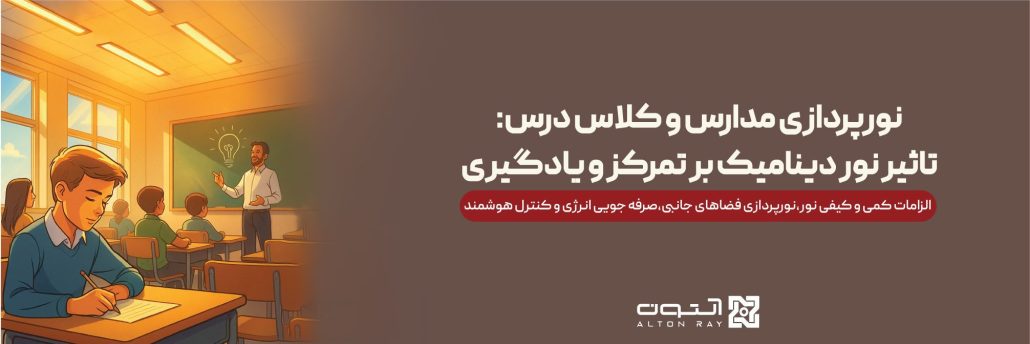
Students spend most of the day under artificial light, so classroom lighting has a direct effect on concentration, reading speed, eye comfort and even mood. A good school lighting design balances enough light on desks and the board, low glare, natural colours and the flexibility to change the atmosphere for lectures, group work, screens and exams. This guide covers the key requirements of EN 12464-1 for educational buildings and how dynamic lighting helps students focus.
Equip your classrooms with Alton Ray linear LED lighting for direct and indirect light, or low-glare panels from our office LED lighting range.
Recommended Lighting Levels for Schools
| Area | Maintained illuminance | UGR limit | Min. CRI |
|---|---|---|---|
| Classrooms (primary and secondary) | 300 lux | < 19 | 80 |
| Classrooms for evening and adult classes | 500 lux | < 19 | 80 |
| Whiteboard and blackboard (vertical) | 500 lux | < 19 | 80 |
| Art rooms | 500 lux | < 19 | 80 (90 recommended) |
| Technical drawing rooms | 750 lux | < 16 | 80 |
| Laboratories and computer rooms | 500 lux | < 19 | 80 |
| Libraries (reading areas) | 500 lux | < 19 | 80 |
| Sports halls | 300 lux | < 22 | 80 |
Board Lighting: The Most Overlooked Detail
Ceiling luminaires light desks well but leave the board too dark or create reflections on glossy whiteboards. A dedicated asymmetric wall-washer luminaire, mounted about one metre in front of the board, gives 500 lux evenly from top to bottom without glare for the teacher or the students. Switch it separately so it can be turned off during projections.
Glare Control and Uniform Light
Children sit in fixed positions and cannot move away from a bright spot, so glare must be controlled at the design stage. Use luminaires with UGR < 19, place rows parallel to the windows and to the main viewing direction, and aim for a uniformity of at least 0.6 on the desks. Linear suspended luminaires with direct and indirect light are ideal: the upward component brightens the ceiling and makes the room feel larger and calmer.
Help Students Focus Better
Send us your classroom layout. We design desk and board lighting with UGR < 19 and the right lux levels for free.
Linear Luminaires for Classrooms
Suspended and surface linear lights with soft, even light. See all →


Dynamic Lighting for Focus and Wellbeing
Research in schools shows that changing light intensity and colour temperature during the day can support concentration and reduce restlessness. A Tunable White system typically offers ready-made scenes:
| Scene | Colour temperature | Light level | Use |
|---|---|---|---|
| Normal | 4000 K | 300 to 500 lux | Everyday lessons |
| Focus | 5000 to 6500 K | 650 to 1000 lux | Tests and demanding tasks |
| Energy | 6500 K | 1000 lux | Morning start or after lunch |
| Calm | 3000 K | 300 lux | Group work, reading, relaxation |
| Presentation | 4000 K | Dimmed, board off | Projector and screen use |
Daylight, Controls and Energy Savings
Classrooms have large windows, so daylight sensors on the window-side row can dim the luminaires automatically when there is enough natural light. Presence sensors switch off lights in empty classrooms, corridors and toilets. Together with LED luminaires, these controls typically cut lighting energy by more than half compared with old fluorescent systems, a significant saving for public school budgets.
Safety and Durability
- Use shatter-proof diffusers (PMMA or PC) instead of glass.
- Choose impact-resistant IK08+ luminaires for sports halls, corridors and stairs.
- Specify flicker-free drivers to protect children’s eyes and avoid headaches.
- Plan emergency lighting for corridors, stairs and exits according to EN 1838.
Classroom Lighting Checklist
- 300 to 500 lux on desks and 500 lux on the board
- UGR < 19 and uniformity of at least 0.6
- Dedicated board luminaire on a separate switch
- CRI 80 or higher, 4000 K as the base colour temperature
- Daylight and presence sensors for energy savings
- Optional Tunable White scenes for focus and calm
Low-Glare Panels for Schools and Libraries
60×60 panels for classrooms, labs and reading areas. See all →

Equipping a Whole School or University?
We prepare one lighting package for classrooms, corridors, labs and sports halls, with energy-saving controls.
FAQ
How many lux does a classroom need?
EN 12464-1 requires 300 lux in standard classrooms and 500 lux for evening classes, laboratories and on the board.
What colour temperature is best for classrooms?
4000 K neutral white is the standard choice. Cooler light (5000 to 6500 K) can support focus during tests, while 3000 K creates a calmer atmosphere.
Are LED lights safe for children’s eyes?
Yes, when you use quality luminaires with flicker-free drivers, low glare (UGR < 19) and photobiological safety group RG0 or RG1.
Can Alton Ray design lighting for a school project?
Yes. Our team prepares free DIALux calculations for classrooms, laboratories, libraries and sports halls.