

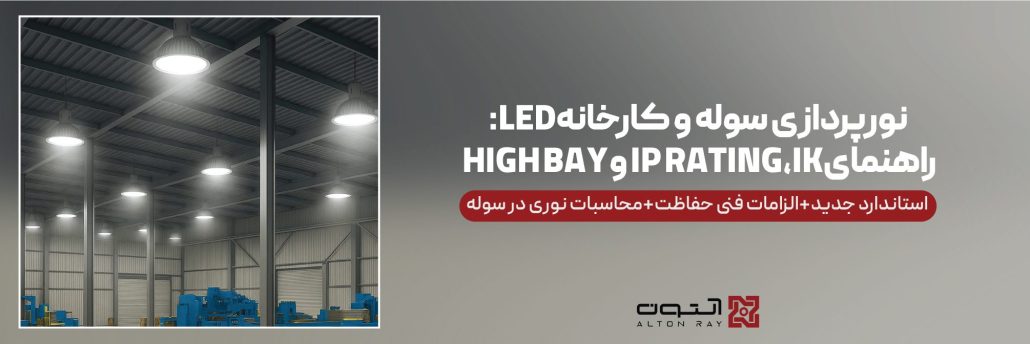
Lighting factories, warehouses and production halls is one of the most critical and challenging areas of the lighting industry. Ignoring environmental factors such as dust, vibration, humidity and impact risk not only endangers staff safety but also drives up operating and maintenance costs dramatically.
Ready to choose fixtures? Compare Alton Ray LED high bay lights and the UFO high bay Sabalan series for warehouses, factories and logistics halls.
This specialist guide focuses on selecting and installing LED high bay lights.
1. LED High Bay: The New Standard of Industrial Lighting
High bay luminaires are designed for high mounting heights (usually 8 m and above). Their main job is to deliver high, uniform illuminance (lux) at the working plane.
1.1. Clear Advantages of LED over Older Technologies
Moving from metal halide and high-pressure sodium to LED high bays is no longer a choice but a technical and economic necessity.
| Criterion | Metal halide (HID) | Alton Ray LED high bay |
|---|---|---|
| Efficacy (lm/W) | 50–100 lm/W | 140–180 lm/W |
| Rated life | 12,000–20,000 h | 50,000–100,000 h (L70/B50) |
| Maintenance (relamping) | Very high and frequent | Very low (almost zero) |
| Start-up time | 15–20 min warm-up | Instant |
| Dimming | Difficult and costly | Easy and standard (DALI / 0–10 V) |
| Colour rendering (CRI) | 60–70 | 80+ |
1.2. High Bay Types and Their Applications
- Round (UFO) reflector high bay: the most common type, with a sturdy aluminium body and excellent heat dissipation. Compact, ideal for very high ceilings and warehouses; usually symmetric light distribution. See the Sabalan UFO high bay series.
- Linear high bay: looks like a large linear luminaire, gives a tidier visual effect and a rectangular light distribution that suits aisles and narrow spaces.
- Low-profile high bay: for medium ceiling heights (about 6–8 m) to avoid glare.
2. Protection Requirements (IP & IK): Surviving Harsh Environments
In industrial halls, luminaires are constantly exposed to dust, vapours and the risk of impact.
2.1. IP Rating: Protection Against Dust and Water
- Dust: cutting, welding, grinding and material handling fill the air with particles. Over time they settle on LEDs and inside the housing, causing lumen depreciation, higher internal temperatures and premature driver and chip failure.
- Required standard: most industrial halls need at least IP65. The “6” means fully dust-tight; the “5” means protection against water jets for surface cleaning.
2.2. IK Rating: Protection Against Impact
- Risks: overhead cranes, forklifts in loading areas, thrown tools or parts, and strong vibration from presses and heavy machinery.
- Required standard: for high-impact areas (above loading lines or low on columns), IK08 is recommended, achieved with thick aluminium housings and polycarbonate (PC) diffusers instead of glass or acrylic.
How Many High Bays Does Your Hall Need?
Give us the hall size and mounting height. We return the exact quantity, wattage and beam angle in a free calculation.
UFO and Industrial High Bays
Efficient high bays for warehouses, factories and logistics halls. See all →

3. Lighting Calculations: Uniformity, Lux and Optics
3.1. Uniformity: Ensuring Safety
Uniformity (minimum lux ÷ average lux) is essential in industrial spaces:
- Warehouses and aisles: U ≥ 0.4, to avoid dark spots and trips.
- General production lines: U ≥ 0.6, for good operator visibility.
- Precision assembly: U ≥ 0.7, to avoid visual errors in fine work.
Alton Ray uses DIALux to design lighting layouts, taking wall colours, mounting height and high bay optics into account to guarantee the required uniformity before installation.
3.2. Choosing Optics by Mounting Height
| Mounting height | Recommended optic | Purpose |
|---|---|---|
| 8–10 m | Wide beam (90° or 120°) | Wide spread and fewer hot spots |
| 10–15 m | Medium beam (60°–90°) | More focus to reach target lux at the work plane |
| 15 m and above | Narrow beam (under 60°) | Long throw and high intensity |
4. Smart Controls and Energy Savings
4.1. Microwave Sensors
Unlike PIR sensors, microwave sensors detect motion through thin walls and plastic barriers and work better on high ceilings. In warehouse aisles with intermittent traffic, luminaires can idle at around 20% output and return to 100% when a forklift or person is detected, saving up to 70% additional energy.
4.2. Dimming and DALI
DALI (Digital Addressable Lighting Interface) lets operators address and control each luminaire individually, which is ideal for layout changes or daylight compensation near windows.
5. Technical Comparison: LED High Bay vs Metal Halide
| Feature | 400 W metal halide high bay | 150 W Alton Ray LED high bay | Key LED advantage |
|---|---|---|---|
| Power (replacement) | 400 W | 150 W | 62.5% lower consumption |
| Luminous flux (approx.) | 32,000 lm | 24,000 lm | Sufficient lux at much lower power |
| Efficacy | 80 lm/W | 160 lm/W | Double the efficiency |
| Protection | Usually IP20 / IP40 | IP65 / IP66 | Fully dust- and moisture-proof |
| Lumen depreciation | 30–50% after 10,000 h | Under 10% after 10,000 h | Stable light over time |
| CRI | 65 | 80+ | Better visibility and safety |
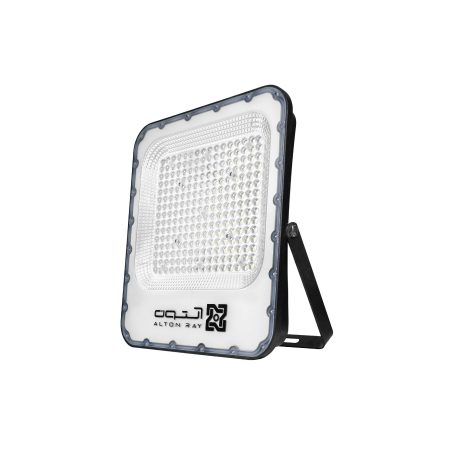
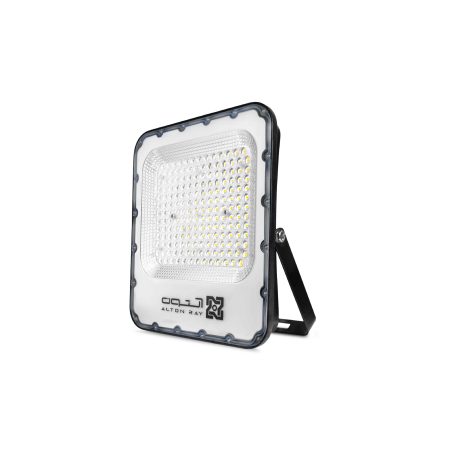
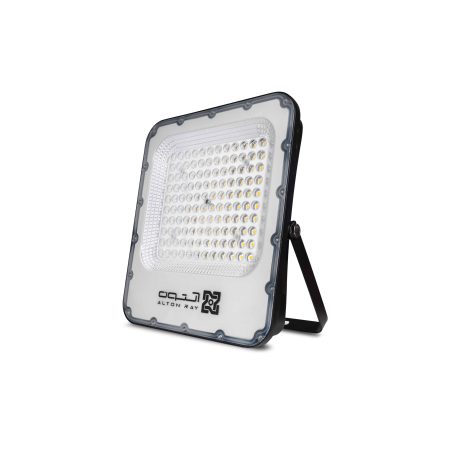
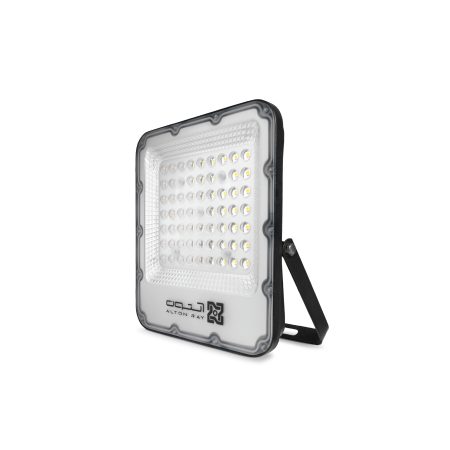
Floodlights for Yards and Loading Bays
IP66 floodlights for outdoor storage, docks and facades. See all →
Replacing Metal Halide Lamps?
Switch to LED high bays and cut lighting energy by more than half. Ask for a payback estimate for your plant.
6. Conclusion
Efficient, safe factory lighting is a pillar of industrial productivity. LED high bays deliver quality light, lower energy bills and eliminate periodic lamp and ballast maintenance. Choosing IP65 for dust resistance, IK08 for physical durability and high efficacy is the key to success.
As a specialist manufacturer of industrial high bay LED lights, Alton Ray offers complete industrial lighting solutions. Need a professional lighting design for your warehouse or factory? Contact Alton Ray for a free DIALux calculation and factory-warranted products.