


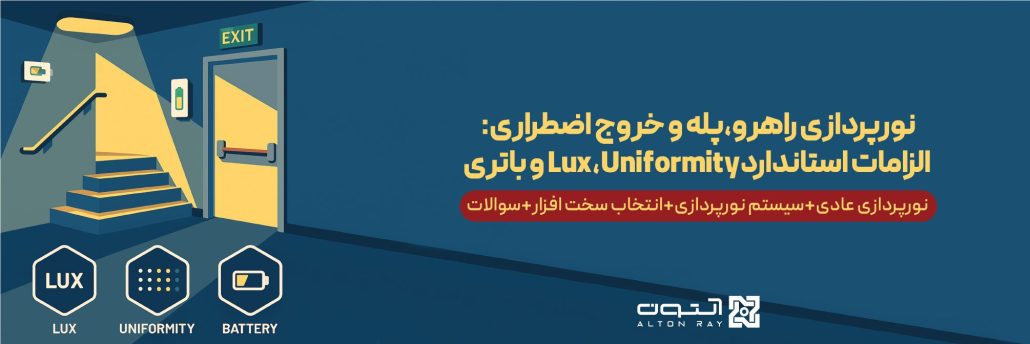
Corridors, stairs and exit routes are the paths people use every day and the only way out in an emergency. Their lighting must give safe orientation in normal operation and keep working when the mains supply fails. This guide summarises the key requirements of EN 12464-1 for circulation areas and EN 1838 for emergency escape lighting: lux levels, uniformity, glare, battery duration and the right luminaire choice for offices, hospitals, schools, hotels and industrial buildings.
Explore Alton Ray emergency LED lighting, including self-contained luminaires for escape routes, and the Soha LED exit sign range.
Normal Lighting for Corridors and Stairs
Required illuminance
| Area | Maintained illuminance | UGR limit | Uniformity (Uo) |
|---|---|---|---|
| Corridors and circulation areas | 100 lux | < 28 | 0.40 |
| Stairs, escalators | 150 lux | < 25 | 0.40 |
| Hospital corridors (day) | 200 lux | < 22 | 0.40 |
| Entrance halls and lobbies | 200 lux | < 22 | 0.40 |
| Loading ramps and bays | 150 lux | < 25 | 0.40 |
Why uniformity matters on stairs
On stairs, poor uniformity creates shadows on the step edges and is a common cause of falls. Place luminaires so that both treads and risers are lit, avoid lighting only from the top landing, and make the transition between the corridor and the staircase smooth so the eye does not need to adapt suddenly.
Glare in long corridors
In long corridors, people look along the ceiling line, so bare light sources in the field of view cause discomfort. Use opal or micro-prismatic diffusers, wall-mounted luminaires that direct light downwards, or recessed downlights with a deep cut-off.
Emergency Escape Lighting (EN 1838)
Types of emergency lighting
- Escape route lighting: lights the floor of the escape route so people can leave safely.
- Exit and safety signs: illuminated pictograms that show the direction to the nearest exit.
- Open area (anti-panic) lighting: for halls larger than 60 m², so people can reach an escape route.
- High-risk task area lighting: allows safe shutdown of dangerous processes.
Emergency lux requirements
| Requirement | Escape route | Open area (anti-panic) | High-risk task area |
|---|---|---|---|
| Minimum illuminance | 1 lux on the centre line | 0.5 lux on the floor | 10% of normal level, min. 15 lux |
| Uniformity (max:min) | 40:1 | 40:1 | 10:1 |
| Response time | 50% in 5 s, 100% in 60 s | 50% in 5 s, 100% in 60 s | 0.5 s |
| Typical duration | 1 to 3 hours | 1 to 3 hours | As long as the risk exists |
Emergency luminaires must also be placed at key points: at every exit door, near each change of direction and level, at stairs, near fire-fighting equipment and first-aid points.
Self-contained luminaires and battery design
A self-contained emergency luminaire has its own battery, charger and changeover unit. In maintained mode it works as a normal light and stays on during a power failure; in non-maintained mode it only switches on when the mains fails. Choose lithium iron phosphate (LiFePO4) or NiCd batteries with at least 3 hours autonomy for hotels, hospitals and public buildings, and plan a monthly function test and an annual full-duration test.
Is Your Building Ready for a Power Failure?
Send us your floor plans. We place escape route luminaires and exit signs to meet EN 1838 and size the batteries.
Emergency Luminaires for Escape Routes
Self-contained emergency lights for corridors, stairs and halls. See all →
 Emergency Lighting Fixture – Sensor-equipped – Microwave – Code DM25View Product
 Morvarid – Surface-Mounted Illumination Light – Emergency – Sensor-equipped – Infrared – Code DM27View Product
 Morvarid – Surface-Mounted Illumination Light – Emergency – Sensor-Equipped –Non- Maintained – Code DM28View ProductMorvarid – Surface-Mounted Illumination Light – Emergency – Sensor-Equipped – Maintained – Code DM24View Product
Choosing Durable Luminaires: IP, IK and Optics
- IK rating: stairs, car parks, schools and public corridors need impact-resistant fittings, at least IK08.
- IP rating: IP20 is enough for dry indoor corridors; external stairs, car parks and wet areas need IP54 to IP65.
- Corridor optics: asymmetric or elongated lenses spread light along the corridor, so fewer emergency luminaires reach the 1 lux requirement.
- Exit signs: the viewing distance of a sign is about 200 times its height for internally illuminated signs, so a 100 mm pictogram is readable from about 20 m.
Smart Control and Lower Running Costs
Corridors are often empty, so occupancy sensors with step dimming are ideal: lights stay at 10 to 20% when nobody is present and rise to full output when someone enters. Combined with LED luminaires and automatic self-test emergency units, this reduces energy use and maintenance visits while keeping the building compliant.
Emergency Lighting Checklist
- 100 lux in corridors and 150 lux on stairs in normal operation
- At least 1 lux on the escape route centre line during a power failure
- Exit signs at every exit and change of direction
- Battery autonomy of 1 to 3 hours depending on building type
- IK08 or higher in public areas, IP65 outdoors
- Monthly function test and annual duration test
Exit Signs and Safety Signage
Illuminated exit signs readable from long distances. See all →
 Soha – Two-Sided Emergency Exit Light, Code SO12View ProductSoha – Emergency Exit Light, Code SO11View Product
 Karen – Surface mounted linear light – Emergency – Non-Maintained – Length 30 Code KA22View ProductKaren – Surface-Mounted Linear Light – Emergency – Maintained – Length 30, Code KA21View Product
Specifying Emergency Lighting for a Project?
We supply complete emergency packages with exit signs, maintained luminaires and test documentation for handover.
FAQ
How many lux is required for emergency lighting?
EN 1838 requires at least 1 lux on the centre line of escape routes, 0.5 lux in open areas and 10% of normal lighting (minimum 15 lux) in high-risk task areas.
How long must emergency lights stay on?
At least one hour, but three hours is required for most public buildings, hotels and hospitals.
What is the difference between maintained and non-maintained emergency lighting?
Maintained luminaires are always on and continue during a power failure; non-maintained luminaires light up only when the mains supply fails.
Can a normal LED panel be used as emergency lighting?
Yes, if it is fitted with an emergency kit (battery and driver) that meets the required duration and output. Contact our team to choose the right kit.